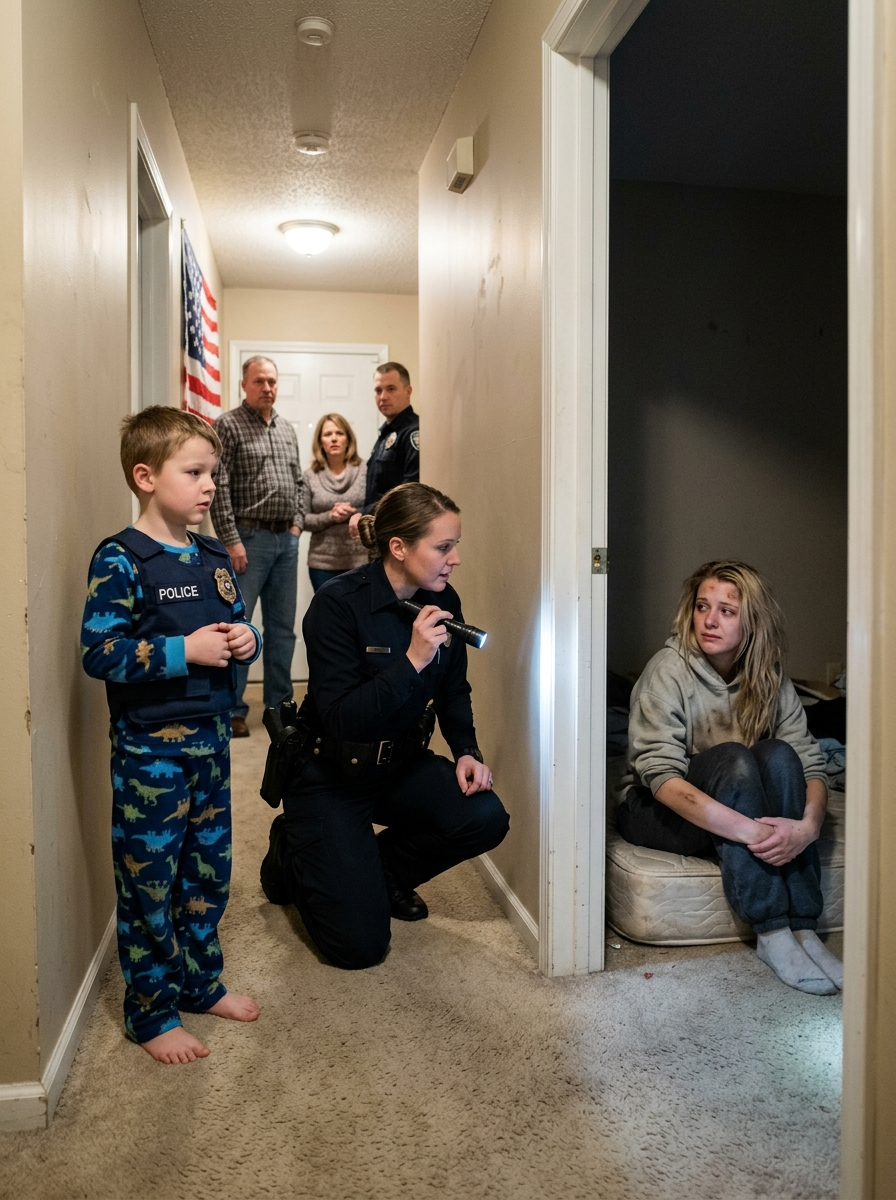
Because Hannah Price did not scream.
She just stared.
Like someone who had spent too long believing nobody was coming.
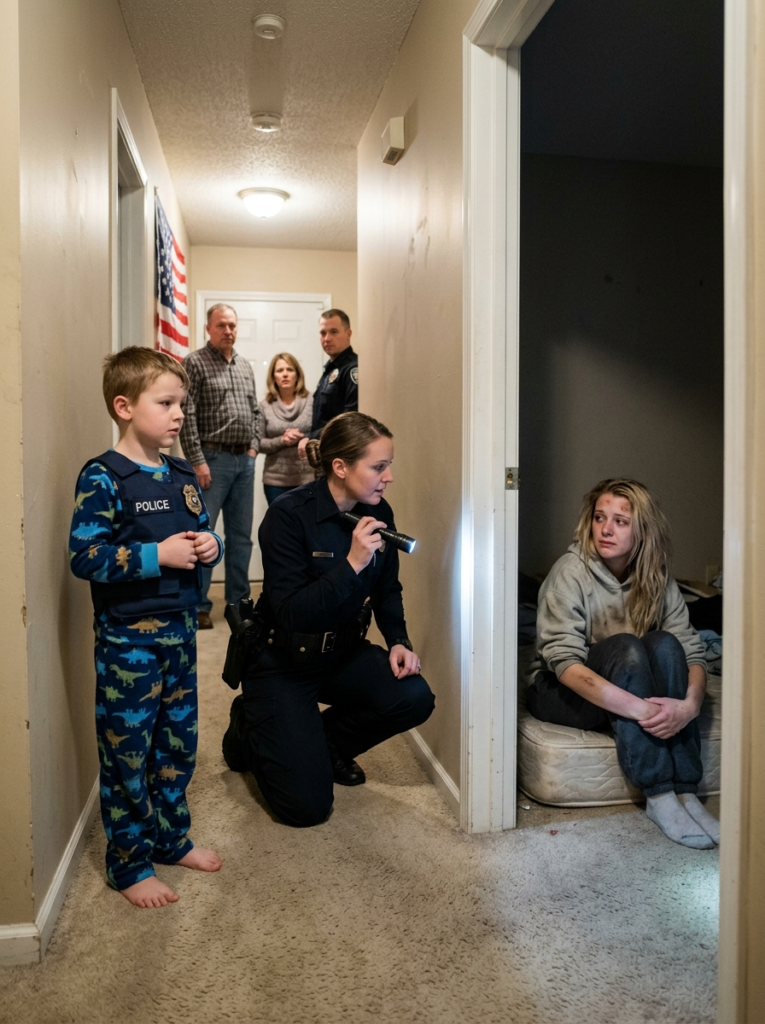
Rain hammered the roof while paramedics rushed through the hallway carrying blankets and medical kits. Red-and-blue police lights flashed across the beige walls of the Miller home, turning family photos into something nightmarish.
Caleb stood frozen beside the staircase hugging a stuffed triceratops to his chest.
His father was face-down on the kitchen floor in handcuffs, breathing hard into the tile while Officer Hill held him down.
“You’re destroying this family!” Richard shouted.
Allison Miller collapsed against the dining room wall sobbing into both hands.
And in the back bedroom, Hannah whispered her first words.
“Is he dead?”
Officer Cole knelt beside her carefully. “No. He’s in custody.”
Hannah’s body began shaking violently.
Not relief.
Shock.
The kind that arrives too late for tears.
Cole helped paramedics lift the chain from her ankle. The skin underneath was raw and infected where metal had rubbed against flesh for weeks. Bruises layered both arms in fading yellows and deep purple rings. Her dark hair had been hacked unevenly near one side like someone cut it with kitchen scissors.
On the mattress beside her sat a plastic tray with stale crackers and a half-empty bottle of water.
Like feeding an animal.
One paramedic quietly turned away to compose himself.
Officer Hill entered the doorway holding Hannah’s driver’s license inside an evidence bag.
“You’re Hannah Price?”
She nodded weakly.
Twenty-six years old.
Graduate student.
Missing for twenty-three days.
Last seen leaving a bookstore café downtown after texting her roommate that she was meeting someone about a tutoring job.
Nobody had connected Richard Miller to her disappearance.
Why would they?
Richard was a middle-school guidance counselor.
Little League volunteer.
Church usher every second Sunday.
The kind of man neighbors described with words like dependable.
That word appears constantly after arrests like this.
Dependable.
As though evil announces itself by looking untidy.
Caleb suddenly appeared near the doorway despite Officer Cole telling him to stay back.
The second Hannah saw him, her expression changed completely.
Softened.
“Oh,” she whispered.
The little boy started crying instantly.
“I told them you weren’t a monster.”
Every adult in that hallway went still.
Officer Cole crouched beside him gently. “Why did you think she was a monster, Caleb?”
His eyes stayed fixed on Hannah.
“Dad said there was something dangerous in the room.” His voice trembled. “He said if I opened the door, she’d hurt Mom.”
Hannah covered her mouth and broke into silent sobs.
Caleb looked terrified suddenly. “Did I do bad?”
“No,” Hannah whispered immediately.
Her voice cracked from dehydration and fear, but she forced the words out anyway.
“You saved me.”
The boy burst into tears.
Officer Cole guided him away while paramedics loaded Hannah onto a stretcher. As they wheeled her through the living room, Allison Miller suddenly lunged forward.
“You don’t understand!” she screamed.
Every officer snapped toward her.
Allison’s mascara streaked down her face now, robe hanging loose off one shoulder.
“He wasn’t supposed to keep her this long!”
The room froze.
Even Richard stopped struggling.
Officer Hill stared at her. “What did you just say?”
Allison realized too late.
The sentence hung there in the flashing lights like something alive.
Richard’s face transformed.
Pure hatred.
Not panic.
Not fear.
Hatred.
“You stupid bitch,” he hissed.
Allison began shaking uncontrollably.
“I didn’t mean—”
“How long?” Hill demanded sharply.
Allison backed into the china cabinet. “I never touched her!”
“That wasn’t the question.”
She looked toward Richard.
Then toward Caleb.
And something inside her finally collapsed.
“Three weeks,” she whispered.
Officer Cole stared at her in disbelief.
“You knew there was a kidnapped woman chained in your house for three weeks?”
Allison screamed suddenly, hands pressed against her head. “You don’t know what he’s like!”
Hannah made a small sound from the stretcher.
Not anger.
Recognition.
Because apparently she did know exactly what he was like.
Detectives arrived within minutes.
Then more patrol cars.
Then crime scene investigators wearing gloves and hard expressions.
The quiet suburban house transformed into a flood of radios, evidence markers, and camera flashes while rainwater streamed down the windows.
And through all of it, Caleb sat alone on the staircase holding his dinosaur toy.
Nobody noticed him for nearly ten minutes.
That part would bother Officer Cole later.
Children disappear emotionally in crisis scenes all the time. Adults become consumed by the loudest horror in the room.
But Caleb had been living inside the horror long before police arrived.
Cole finally sat beside him carefully.
“You were very brave tonight.”
He stared at the front door.
“I thought maybe Dad would kill her.”
The words landed like stones.
“Why did you think that?”
Caleb swallowed hard.
“Because of the other lady.”
Cole’s blood went cold.
“What other lady?”
The boy looked confused by the question.
“The crying lady before this one.”
Silence.
Absolute silence.
Even the officers searching the hallway seemed suddenly farther away.
Officer Cole kept her voice calm with effort. “Caleb… has there been someone else in that room before Hannah?”
He nodded once.
“How many?”
“…Two.”
Detective Ray Navarro overheard the answer from across the room and turned immediately.
“When?” he asked carefully.
Caleb looked down at the dinosaur toy.
“One was last winter.”
Every detective in the room changed expression at once.
Because now this was no longer a kidnapping.
It was potentially something far worse.
Navarro crouched in front of the child.
“Did those women leave the house?”
Caleb hesitated.
Then whispered:
“I don’t think so.”
Crime scene investigators tore the Miller house apart until nearly dawn.
At 2:14 a.m., they found the first hidden item.
A silver necklace shoved deep into a heating vent behind the locked bedroom wall.
The initials engraved on the back matched another missing woman from eight months earlier.
Twenty-one-year-old college student Rebecca Vance.
Still unsolved.
At 2:47, investigators uncovered blood traces beneath newly replaced basement flooring.
At 3:11, officers found dozens of Polaroid photographs hidden inside Richard Miller’s garage workshop.
Women.
Different women.
Bound.
Drugged.
Crying.
Some alive.
Some possibly not.
Officer Hill stepped outside into the storm afterward and vomited beside the patrol car.
Inside the house, Allison Miller finally started talking.
Not because she wanted justice.
Because Richard had stopped looking at her like a wife.
Now he looked at her like a witness.
And Allison Miller understood she might become disposable too.
“He met them online,” she whispered during interrogation. “He used fake tutoring programs. Fake church counseling. Sometimes dating apps.”
Detective Navarro recorded every word.
“How many women?”
“I don’t know.”
Lie.
Navarro leaned forward. “How many?”
Allison started crying.
“Seven.”
The room went silent.
She covered her face. “Maybe more.”
Meanwhile, forensic teams returned to the locked bedroom.
The smell of bleach could not hide what existed underneath years of cleaning.
Scratches on the radiator pipe.
Handprints beneath paint.
Tiny tally marks carved into the underside of the bed frame.
Someone had counted days in that room.
Maybe multiple someones.
At 4:26 a.m., they found the crawl space.
Hidden behind shelves in Richard’s garage.
Officer Cole stood nearby when investigators pried it open.
The odor rolled out first.
Old decay trapped in wet earth.
One investigator removed his mask immediately and stepped backward.
Another whispered, “Jesus…”
Inside the crawl space lay a woman’s shoe.
Then another.
Then bones.
Small ones.
Human.
Officer Cole closed her eyes briefly.
Because upstairs, asleep in a pediatric observation room at county services, nine-year-old Caleb Miller still believed monsters looked different from fathers.
And somewhere between bedtime stories, school lunches, and Saturday basketball practice, that child had learned the sound a chained woman makes when she cries behind a locked door.By sunrise, the Miller house no longer belonged to the family who had lived there.
It belonged to evidence.
Yellow crime-scene tape fluttered across the soaked front yard while satellite news vans lined both sides of the street. Neighbors stood on porches clutching coffee mugs and robes, speaking in whispers about the family they thought they knew.
The Millers hosted block parties every summer.
Richard grilled hamburgers in an apron that said WORLD’S BEST DAD.
Allison brought homemade cupcakes to school fundraisers.
Caleb rode his bike in circles beneath maple trees while neighbors waved from driveways.
Normal.
That word again.
Normal is the camouflage evil wears best.
Inside county child services, Caleb sat curled beneath a gray blanket watching rain crawl down the windows. Someone had given him hot chocolate he never touched.
Officer Jenna Cole stayed with him because every time another adult left the room, he panicked.
“Are they taking my dad to jail forever?” he asked quietly.
Cole chose her answer carefully.
“Your dad hurt people.”
Caleb stared at the blanket threads.
“He hurt me too sometimes.”
The words came so softly she almost missed them.
Her chest tightened.
“How?”
The boy shrugged automatically, like pain had become ordinary enough not to measure anymore.
“He’d lock me in the garage when I asked questions.” He paused. “One time I tried to give the crying lady water.”
Cole kept her expression steady with effort.
“What happened?”
“He said boys who disobey become useless men.”
Caleb’s small fingers twisted tighter into the blanket.
“He made me kneel on rice for a long time.”
Officer Cole looked away for one dangerous second because rage has no place near children, and hers was becoming difficult to hide.
A social worker entered quietly carrying a paper bag from the evidence unit.
“Found these in his room.”
Inside were crayon drawings.
Lots of them.
At first glance they looked ordinary—houses, trees, family pictures.
Then Cole noticed every drawing included one detail repeated over and over.
A dark square in the back of the house.
Sometimes with eyes behind it.
Sometimes chains.
In one drawing, a stick-figure boy stood in front of police cars while a woman reached toward him from a window.
Children tell the truth long before adults are willing to hear it.
Nobody had listened.
Back at the Miller residence, forensic anthropologists carefully excavated the crawl space beneath the garage.
By 9:13 a.m., they confirmed the remains belonged to at least two individuals.
Both female.
One likely under twenty-five.
Detective Ray Navarro stood in the driveway watching investigators carry evidence boxes into vans while reporters shouted questions from behind barricades.
“How long was this going on?”
“Did the wife participate?”
“Were there more victims?”
Navarro ignored all of them.
Because he had just come from interrogation room three.
And Allison Miller had finally broken completely.
“She wasn’t the first one he brought home,” Allison whispered through swollen eyes.
The recording clock blinked red on the table between them.
Navarro sat silently.
Experienced detectives understand something important about confessions:
Silence pulls harder than questions.
Allison stared at her shaking hands.
“The first girl was four years ago.”
Navarro’s pulse slowed dangerously.
Four years.
“How did Richard choose them?”
She swallowed hard. “Women without close family. Students. Girls new in town.” Her voice cracked. “He said nobody looks hard for lonely people.”
Navarro felt physically sick.
Allison continued staring at the table while speaking.
“At first he only watched them.”
“Watched them?”
“He made fake profiles online. Followed routines. Took pictures.” Tears slid down her face. “Then one day he brought Rebecca home.”
The missing college student.
The necklace from the heating vent.
Navarro leaned forward slightly. “Alive?”
Allison closed her eyes.
“For a while.”
The room went dead silent.
“Tell me exactly what happened.”
And Allison did.
Not all at once.
In pieces.
Like someone vomiting broken glass.
Richard used the locked bedroom because it sat farthest from Caleb’s room. Music played through hallway speakers whenever victims cried too loudly. Allison claimed she tried not to know details, but details leaked anyway.
Bruises.
Begging.
Blood in laundry water.
The first time she threatened to leave, Richard calmly showed her a folder filled with forged financial records and life insurance paperwork naming her responsible for massive debts.
“He said if I ran, Caleb would grow up believing I abandoned him.”
Navarro watched her carefully.
Victim.
Accomplice.
Coward.
Maybe all three.
“What happened to Rebecca Vance?”
Allison broke completely then.
Ugly choking sobs that bent her double over the interrogation table.
“She got sick,” she whispered.
Navarro already knew.
Infections.
Starvation.
Injuries untreated too long.
The same ending investigators see again and again in captivity cases.
“What did Richard do with the body?”
Allison shook uncontrollably.
“The crawl space.”
By noon, national media had picked up the story.
The Perfect Family Horror.
Neighbors gave interviews crying into cameras.
“Nobody could believe it.”
“He coached Little League.”
“He seemed devoted to his son.”
Every sentence sounded like a confession from people realizing evil had smiled at them across backyard fences.
But the most important person in the case sat quietly coloring dinosaurs in a child advocacy room downtown.
Caleb refused to sleep unless Officer Cole stayed nearby.
At 1:42 p.m., child psychologist Dr. Mira Patel gently began asking questions.
Not leading.
Not forceful.
Just patient.
Caleb answered while coloring with blue crayons.
“Dad said the women were bad.”
“What made them bad?”
“They tried to leave.”
Dr. Patel’s expression never changed.
“Did you ever see your father hurt them?”
The crayon stopped moving.
A long pause.
Then:
“One time.”
Cole felt her stomach knot.
“What happened?” Patel asked softly.
Caleb stared down at the paper.
“The dark-haired lady screamed because of the stairs.”
“What stairs?”
“The basement stairs.”
Patel glanced briefly toward Cole.
“There’s a basement in the house?”
Caleb nodded.
Police had searched the basement already.
Storage shelves.
Laundry area.
Nothing unusual.
But children often notice truths adults miss.
Patel kept her voice gentle. “What happened in the basement?”
Caleb whispered the answer so quietly Cole barely heard it.
“There’s another room.”
Everything stopped.
Within twenty minutes, detectives were back at the Miller house tearing apart the basement walls.
At 3:06 p.m., they found it.
A hidden concrete chamber concealed behind shelving units bolted into the foundation.
Soundproofed.
Windowless.
A mattress on the floor.
Handcuffs attached to pipes.
And dozens upon dozens of videotapes stacked neatly inside waterproof bins.
Detective Navarro stood frozen in the doorway while crime scene photographers documented the nightmare.
Because suddenly the scope changed again.
This was not impulsive violence.
Not isolated kidnappings.
This was systemized.
Planned.
Practiced.
A long-term operation hidden beneath family dinners and neighborhood cookouts.
One investigator opened a locked toolbox near the wall.
Inside were driver’s licenses.
Eight of them.
Different women.
Some missing.
Some never reported missing at all.
One name made Navarro’s blood run cold.
Emily Graves.
Age seventeen.
Missing six years earlier.
Declared dead after search efforts failed.
A veteran detective beside him whispered, “My God…”
But the worst thing in the room wasn’t the restraints.
Or the IDs.
Or even the tapes.
It was the children’s drawings taped beside the mattress.
Simple crayon pictures.
Flowers.
Suns.
Animals.
Made by Caleb.
Left there because a little boy thought the crying women might feel less scared if they had something pretty to look at in the dark.
And upstairs, hidden inside a kitchen junk drawer beneath old batteries and expired coupons, investigators found a folded piece of notebook paper in childish handwriting.
A note Caleb had apparently tried to leave for one of the victims.
It read:
PLEASE DON’T DIE.
I’M SORRY I CAN’T OPEN THE DOOR.
I TRIED ONE TIME BUT DAD HIT ME.
I THINK POLICE ARE GOOD PEOPLE.