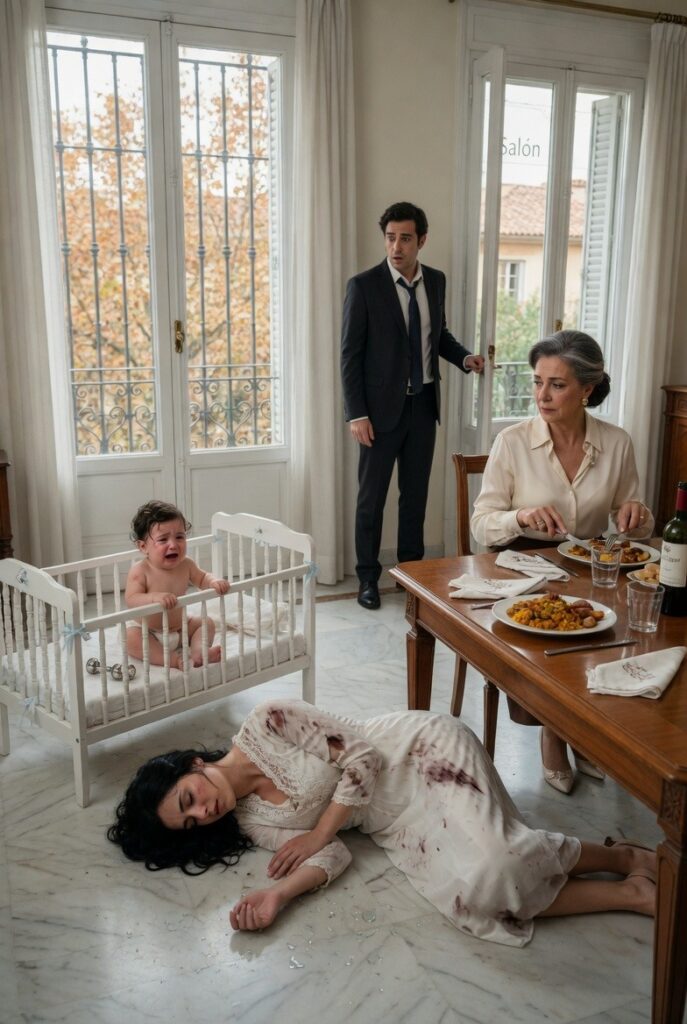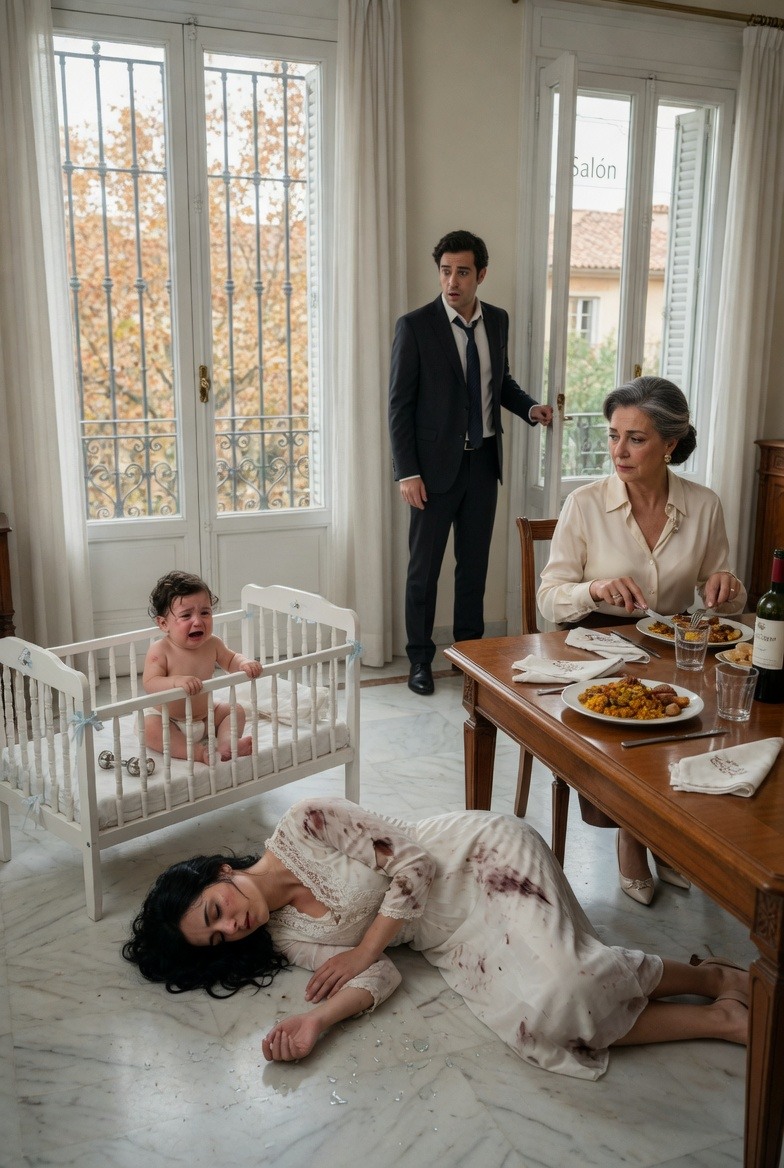
“Get out.”
The words landed hard in the room.
Not loud.
Not shouted.
That was what finally made her put the fork down.
My mother blinked once, like she genuinely believed she had misheard me. “Excuse me?”
“You heard me.”
I bent down carefully, sliding one arm under Alina’s knees while still holding Liam against my chest. My wife felt terrifyingly light. Her head rolled weakly against my shoulder, lips parted, eyelashes damp with sweat.
The pediatrician’s warning echoed in my skull.
Rest. Hydrate. Watch for fainting.
And suddenly dozens of tiny things I had ignored over the last three weeks rearranged themselves into something horrifyingly clear.
The dark circles under Alina’s eyes.
The way she always said she had “already eaten.”
The laundry somehow always done.
The full meals my mother praised herself for “helping prepare” even though Alina had stitches that still hurt when she stood too fast.
The fact that every time I came home, my mother looked rested while my wife looked like she was disappearing inch by inch.
Behind me, my mother scoffed. “Don’t be ridiculous, David. Put her down and stop acting emotional.”
Emotional.
My son had cried himself hoarse.
My wife was unconscious on hardwood floors.
And my mother called me emotional.
I looked at her over my shoulder.
“No,” I said quietly. “What’s ridiculous is that you sat there eating while my wife collapsed.”
“She’s lazy.”
The word hit harder than screaming would have.
“She sleeps all day. The baby cries because she spoils him. Women today have no stamina. When you were an infant, I cooked, cleaned, and hosted guests.”
I stared at her.
And for the first time in my life, I noticed something chilling.
She did not care that Alina had fainted.
Not secretly.
Not deep down beneath pride or stubbornness.
She truly did not care.
To my mother, exhaustion was weakness. Pain was manipulation. Compassion was indulgence. And anyone who failed to perform at the level she demanded deserved punishment for disappointing her.
Including my wife.
Including a newborn.
Including me.
Liam whimpered against my chest, exhausted from screaming.
That tiny sound snapped me back into motion.
I grabbed the diaper bag near the stairs with my foot and headed for the front door.
My mother finally stood.
“Where do you think you’re going?”
“To protect my family.”
“This is my house too.”
“No,” I said flatly. “It isn’t.”
“You ungrateful boy.”
Boy.
Not man.
Not husband.
Not father.
Because in her mind, I had never grown into someone separate from her. I was still something she owned.
She followed me down the hallway, cardigan sleeves brushing against the wall as her voice sharpened.
“She turned you against me.”
I ignored her.
“She’s weak, David.”
I opened the front door.
“She’s manipulating you.”
The evening air hit my face.
“She’ll ruin your life.”
I turned then.
Not angry.
Just done.
“No,” I said. “You were already doing that.”
For a second, silence swallowed everything.
Even my mother looked startled.
Because people like her survive on one thing above all else: the belief that nobody will ever truly leave them.
I stepped outside.
She followed onto the porch just as I reached the car.
“You can’t take my grandson away from me.”
That sentence almost made me laugh.
Not because it was funny.
Because Liam had screamed himself red while she ate steak ten feet away, and somehow she still thought the title of grandmother mattered more than the actual act of caring.
I strapped Liam into his car seat first.
Then I laid Alina carefully across the backseat, supporting her head while she stirred weakly for the first time.
“David…?”
“I’ve got you,” I whispered.
Her eyes barely opened. “I’m sorry. I was making dinner and then I got dizzy and your mom said I was being dramatic and—”
“You do not apologize,” I said immediately.
Her face crumpled.
That destroyed me more than finding her on the floor.
Because it meant she had been blamed for suffering so often she apologized automatically.
I shut the car door before my mother could hear the sound that came out of me then.
Not a sob.
Something lower.
A breaking.
My mother stood at the end of the driveway with her arms folded tight against herself.
“You’re overreacting,” she called out. “You’ll come crawling back after she turns the baby against you too.”
I stared at her through the windshield.
Then I backed out of the driveway without another word.
—
The emergency room doctor told me Alina was severely dehydrated, sleep deprived, and dangerously overexerted.
“Has she been getting help at home?” he asked carefully.
The question sat between us like a loaded weapon.
Alina looked down.
I answered for her.
“No,” I said.
The doctor nodded slowly like he already suspected that.
They gave her fluids. Checked her blood pressure three times. Brought blankets. A nurse fed Liam while Alina cried quietly into the hospital pillow because someone was finally taking care of her instead of demanding things from her.
Around midnight, after she fell asleep holding my hand, I sat beside the hospital bed and opened my phone.
Thirty-two missed calls from my mother.
Fourteen texts.
YOU HUMILIATED ME.
THIS IS HER FAULT.
A GOOD SON WOULD NEVER DO THIS.
YOU OWE ME.
Then finally:
IF YOU DON’T ANSWER ME RIGHT NOW, I’LL COME TO THE HOSPITAL.
That one made my decision easy.
I blocked her number.
Then I called a locksmith.
By morning, every lock on my house had been changed.
The garage code reset.
The alarm password updated.
And my mother’s key—the one I had once handed over with trust—no longer opened anything.
—
We moved into a hotel for two weeks.
Not because we had nowhere else to go.
Because Alina flinched every time her phone buzzed.
Because she whispered, “What if she comes back?” when footsteps passed our hallway door.
Because healing sometimes starts with distance.
I watched my wife sleep for almost an entire day while nurses checked on her and room service trays piled up beside untouched flowers from coworkers and friends.
No flowers came from my mother.
Only rage.
Voicemails from unknown numbers.
Emails accusing Alina of abuse.
Messages to relatives claiming I had “abandoned” my own mother after “everything she sacrificed.”
But my favorite was the voicemail my aunt accidentally forwarded me.
My mother’s voice hissed through the speaker:
“He’ll calm down eventually. He always does.”
I listened to it three times.
Then deleted it.
Because for the first time in my life, she was wrong.
I wasn’t calming down.
I was waking up.
And my mother still had no idea how much she was about to lose.