Family
“Was three hundred thousand a month not enough?” she asked again.
I stared at her.
“Grandma,” I said, “what are you talking about?”
Eleanor Whitmore was not a dramatic woman.
She had built Whitmore Storage Group from a regional warehouse company into a private holding business with industrial buildings, cold-storage facilities, medical offices, and land parcels across three states.
She had spent her life in rooms where men underestimated her because she was quiet.
She had taught me early that silence was not weakness if you knew what you were saving your voice for.
But I had never heard her ask a question like that.
Not to me.
Not while I was sitting in a hospital bed with stitches, swollen eyes, and a newborn who barely knew how to breathe without startling herself awake.
“I have wired three hundred thousand dollars on the first business day of every month since your wedding,” she said.
The words did not land all at once.
They came apart in pieces.
Three hundred thousand.
Every month.
Since my wedding.
“I assumed you were choosing to live simply,” she continued.
“I assumed you were saving, investing, building something prudent.”
Her eyes moved again to the hidden envelope.
“I did not assume this.”
Layla made a soft sound against me.
I put one palm flat across her back.
Some animal part of me believed that if I held her tightly enough, the room would stop shifting beneath us.
“I never received a single dollar,” I said.
The statement came out flat.
No tears.
No drama.
Just the truth, too large to decorate.
There are moments when life does not explode.
It simply moves one inch to the left, and nothing ever lines up again.
My grandmother did not gasp.
She did not rush to my bedside and tell me everything would be fine.
She opened her handbag, took out her phone, and called Diane.
Diane had worked for my grandmother for years.
I knew her as the woman who remembered every signature page, every clause, every quiet risk other people missed.
“Diane,” Eleanor said when the call connected, “I need you at St. Vincent’s right now.”
She listened for barely a breath.
“Bring everything you can pull in the next hour.”
Another pause.
“No, not tomorrow. Now.”
Her eyes did not leave my face.
“Yes,” she said.
“The Mercer account. All of it.”
Then she hung up.
The hospital room kept making its little ordinary sounds.
The monitor ticked.
Rain tapped the window.
A cart rolled somewhere down the hallway.
A nurse laughed softly at the desk, far enough away that the sound felt like it belonged to another world.
I looked at the envelope under the magazine.
It was still just paper.
But now it looked like evidence.
“Grandma,” I whispered, “what account?”
Only then did Eleanor come closer.
She pulled the visitor chair to the side of my bed but did not sit right away.
She looked at Layla properly, and for one second the steel went out of her face.
“She is beautiful,” she said.
I nodded.
If I had tried to answer, I would have made a sound that frightened both of us.
Eleanor sat down.
“When you married Ethan,” she said, “I established a household support transfer.”
I did not move.
“Not a trust,” she said, “which I now know was my mistake.”
She looked toward the door as if already measuring the next step.
“A monthly transfer to an account designated for household use.”
I could hear the words.
I could not make them fit inside my life.
“Mortgage,” she said.
“Medical bills.”
“Childcare.”
“Savings.”
“Investments.”
“Freedom.”
That last word struck harder than all the money.
Freedom.
I thought of the nights I had counted coupons on the kitchen counter while Ethan said discipline was what separated serious couples from reckless ones.
I thought of putting strawberries back at the grocery store because they were not on sale.
I thought of standing in the pharmacy aisle, heavily pregnant, comparing prenatal vitamins while Ethan texted that brand names were marketing traps.
I thought of telling myself I was lucky because my husband cared about the future.
Money shame is a strange cage.
The bars look like responsibility until you try to leave.
“Ethan said cash flow was tight,” I said.
Eleanor’s mouth barely moved.
“Did he.”
“He said his deals were delayed.”
I heard myself talking faster because once truth starts moving, it drags everything behind it.
“He said we needed to be careful until the next close. He said I needed to stop thinking like a single person. He said marriage meant sacrifice.”
I looked down at Layla.
Her tiny mouth opened and closed in sleep.
“I picked up night inventory shifts at a pharmacy chain,” I said.
My grandmother became very still.
“Twice a week at first,” I continued.
“Sometimes three.”
My voice stayed quiet because the baby was sleeping, but my hands had started to shake.
“I stopped last week because Dr. Holland said my blood pressure was too high.”
Eleanor closed her eyes.
When she opened them, she looked older.
Not weaker.
Older the way mountains look old.
“How much access did you have to the account?” she asked.
“I had a card.”
“A login?”
“At first.”
“At first?”
I swallowed.
“Ethan changed the password because of some security issue.”
My grandmother did not blink.
“He said he would reset it when things settled down.”
“When was that?”
I looked at the rain on the window and tried to count backward.
Months did not feel like months in pregnancy.
They felt like swelling ankles, lists taped to the fridge, receipts folded in my wallet, and small humiliations I had renamed discipline so I could survive them.
“Eight months,” I said.
“Maybe nine.”
Eleanor’s hand tightened around her phone.
One vein rose along the back of it.
I wanted to call Ethan right then.
I wanted to scream into the phone until the whole ward heard me.
I wanted to ask him how a man could watch his pregnant wife put food back on a shelf while three hundred thousand dollars landed somewhere every month.
I did none of those things.
I looked at my newborn daughter and pressed my palm gently against her back.
There are decisions you make because you are brave.
There are decisions you make because a baby is asleep on your chest and you refuse to let rage be the first storm she learns.
The footsteps came fast in the hallway.
Then they stopped outside my door.
The handle turned.
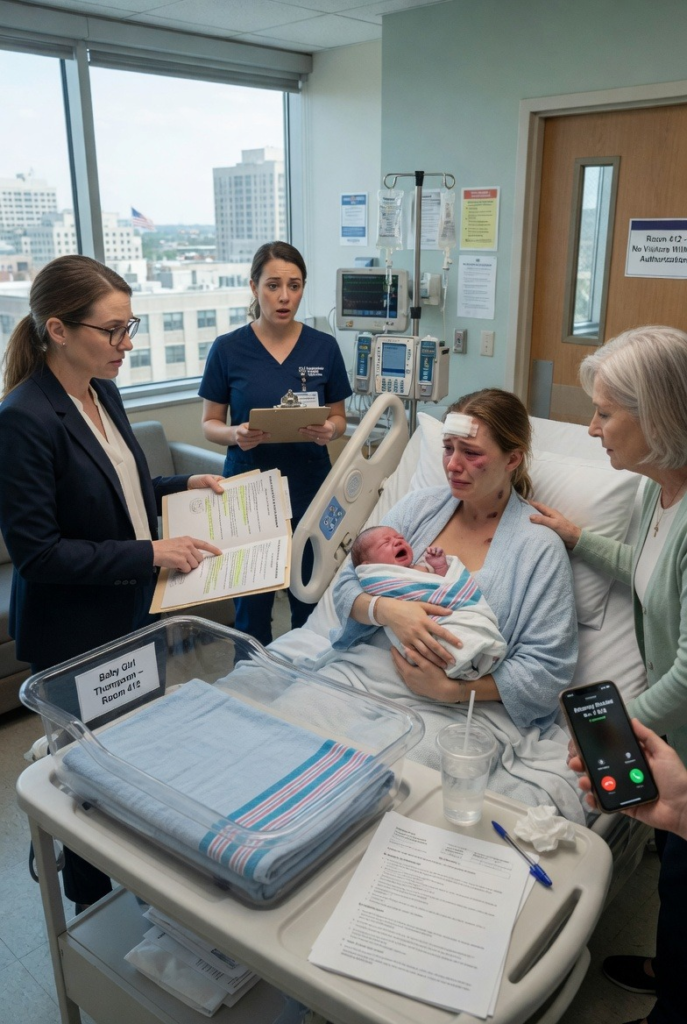
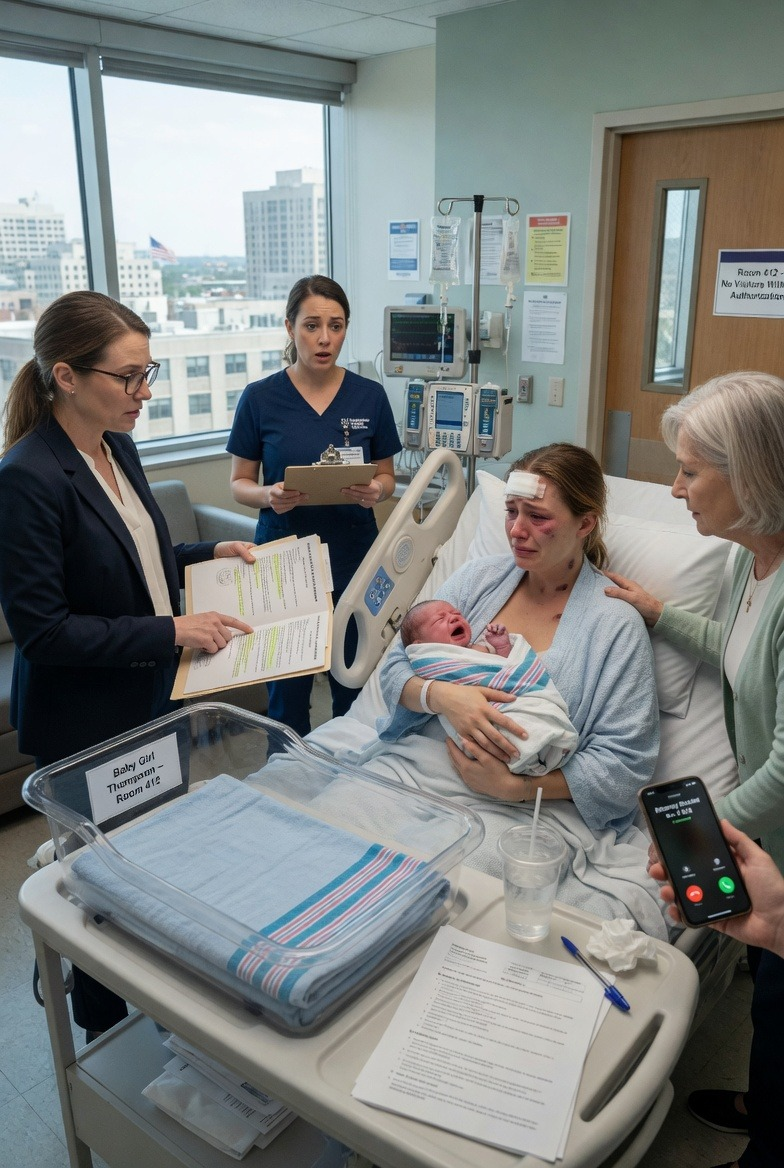
Diane entered with her coat damp from the rain and a black portfolio clutched under one arm.
Across the front was a printed label.
MERCER ACCOUNT.
She did not ask whether she was interrupting.
She looked at my grandmother, then at me, then at the baby, and whatever she had planned to say changed in her mouth.
Eleanor stood.
“Close the door,” she said.
Diane closed it.
The room became smaller.
She laid the portfolio on the rolling tray beside my untouched oatmeal.
The metal tray rattled softly.
My daughter slept through it.
Diane opened the portfolio with the careful hands of someone who understood that paper could cut deeper than glass.
The first page was a wire transfer ledger.
The same number appeared month after month.
$300,000.
First business day.
Household support.
Mercer account.
My married name was typed at the top.
Naomi Mercer.
The sight of it made me feel almost embarrassed, as if I had somehow been caught not knowing my own life.
Diane turned the next page.
Then the next.
Statements.
Authorizations.
Access logs.
Process notes.
A printed record of money that had been closer to me than the hospital tray and still unreachable.
“Ethan told me we had to delay the nursery furniture,” I said.
No one answered.
“He said cribs were overpriced.”
Still no one answered.
I thought of the folding bassinet we had assembled in the bedroom while he told me not to get emotional over aesthetics.
I had laughed because I wanted to be the kind of wife who could laugh at being practical.
That was the worst part.
Not one lie.
The training.
He had taught me to defend the cage.
Diane clipped one page loose and turned it toward my grandmother.
Her face had gone pale.
“There was an access change,” she said.
Eleanor’s voice dropped.
“When?”
Diane read from the page.
“7:46 p.m. Eight months ago.”
The week Ethan told me there had been a security issue.
The week I stopped seeing the account dashboard.
The week I started asking before buying groceries over eighty dollars.
I stared at the timestamp until the numbers blurred.
Diane turned another page.
“This is the authorization notice,” she said.
Her voice was professional, but it trembled at the edge.
Eleanor did not reach for it.
“Naomi needs to see it.”
Diane hesitated.
That hesitation scared me more than the page.
Then she turned it toward me.
There was a signature line.
There was an account control field.
There were initials beside a clause I did not remember seeing.
And there was Ethan’s name.
Not hidden.
Not disguised.
Not buried under confusing language.
Ethan Mercer.
I waited for my body to react.
For tears.
For nausea.
For some movie version of betrayal.
Instead, I felt quiet.
Dangerously quiet.
Eleanor looked at me, and I realized she recognized that silence.
She had lived long enough to know when a woman was not collapsing.
She was becoming clear.
Diane pressed her fingers to her mouth.
“I’m sorry,” she whispered.
It was the wrong apology and the right one at the same time.
I looked at my daughter’s bracelet.
Layla Grace Mercer.
For the first time since my wedding, that last name did not feel like family.
It felt like a question.
“Did he take it?” I asked.
Diane looked at Eleanor before answering.
Eleanor gave one short nod.
Diane moved carefully.
“The transfers came in exactly as Mrs. Whitmore arranged them,” she said.
“The household account stayed funded.”
She swallowed.
“But your access was removed, and most of the funds were moved out through internal transfers.”
“Moved where?”
Diane looked down at the page.
“Accounts controlled by Ethan.”
The room went so silent that I could hear rainwater ticking against the window ledge.
I thought about every dinner I had made from whatever was cheapest.
Every time I apologized for needing new shoes because my feet had swollen.
Every time Ethan told me I was letting pregnancy make me dramatic.
Every time I believed him because believing him was easier than admitting I was alone in a marriage.
Eleanor picked up her phone.
Then she stopped.
She looked at me first.
“Naomi,” she said, “before I make the next call, I need to ask you something.”
I already knew what she meant.
This was the moment when people expected a woman to be reasonable.
To think of the baby.
To avoid making a scene.
To hear all the soft words people use when they are really asking you to keep suffering quietly so nobody else has to be uncomfortable.
My grandmother had never been soft that way.
“Do you want me to lock him out?” she asked.
The words were plain.
Almost practical.
That made them holy.
I looked at Layla.
She stretched one hand, five fingers opening into the air like she was reaching for a world she had not yet learned to fear.
I thought of the household account.
The hospital bill.
The night shifts.
The strawberries put back on the shelf.
The sweatshirt cuff scratching my wrist.
An entire marriage had taught me to wonder if comfort was something I had to earn.
My daughter would not learn that from me.
“Yes,” I said.
Eleanor did not smile.
She nodded once.
“Diane,” she said, “document everything.”
Diane was already moving.
She photographed the billing envelope under the magazine.
She photographed the declined lactation upgrade form.
She photographed my wristband, Layla’s wristband, and the wire transfer ledger.
Not because those things were emotional.
Because they were proof.
She wrote down the time.
10:38 a.m.
She listed the hospital room.
She noted the account access change timestamp, the authorization notice, and the monthly transfer schedule.
Eleanor made the first call in the hallway because I asked her not to wake the baby.
I heard only pieces.
“Freeze access.”
“No, not pending review. Now.”
“Send written confirmation.”
“Counsel will follow.”
I did not feel powerful.
I felt stitched, sore, exhausted, and frightened.
But I also felt something I had not felt in months.
A door.
Not opened yet.
Just there.
When Ethan called twenty minutes later, I watched his name light up my phone.
My thumb hovered over the screen.
For a second, I saw the version of myself from the grocery store aisle.
The woman who would have answered quickly, apologized first, and tried to make her voice pleasant.
Then Layla sighed against me.
I let the call ring.
Eleanor returned to the room and looked at the phone.
“Your choice,” she said.
That was the first gift anyone had given me in a long time.
Not money.
Not advice.
Choice.
I did not answer.
The call ended.
A text appeared seconds later.
Why is Diane calling the bank?
Then another.
Naomi, answer me.
Then a third.
This is not how adults handle problems.
I almost laughed.
Not because it was funny.
Because I finally heard the shape of him.
He had not been protecting our future.
He had been protecting his control.
Diane placed a fresh sheet of paper on the tray.
It was a simple list.
Hospital billing office.
Account documentation.
Counsel.
Safe housing plan.
Pediatric follow-up.
She did not call it escape.
She did not make it dramatic.
She just gave each step a line, as if my life could be rebuilt by doing the next right thing in order.
By late afternoon, the billing envelope was no longer hidden.
It sat on top of the portfolio, clipped to Diane’s notes.
The declined upgrade form sat beside it.
My daughter’s bracelet and mine had been photographed, recorded, and returned to our wrists.
Ethan kept calling.
Then he stopped.
That scared me more than the calls.
But fear was different now.
Before, fear had been a room with no doors.
Now it had names, times, documents, witnesses, and a woman standing beside my bed who knew exactly how to turn facts into consequences.
When Layla woke, I fed her while rain softened against the window.
Her tiny hand opened and closed against my sweatshirt.
The same sweatshirt I had been ashamed of an hour earlier.
I looked down at the frayed cuff and saw it differently.
It was not proof that I had failed.
It was proof of what I had survived while money meant for my safety was being used to keep me small.
An entire marriage had taught me to wonder if comfort was something I had to earn.
That afternoon, with my newborn breathing against my chest and my grandmother’s black portfolio open beside the hospital bill, I began learning something else.
Freedom does not always enter loudly.
Sometimes it walks into a hospital room carrying a folder.
Sometimes it asks the question that breaks the lie.
Sometimes it looks like not answering the phone when the man who controlled the password finally realizes the account is no longer his.